


What is an anti-vibration mount?
Physical principles, types and selection criteria
Every mechanical system in motion generates vibrations. Left uncontrolled, these transmit through structures, generate noise, accelerate wear and reduce precision. An anti-vibration mount is the component that interrupts this transmission — but choosing the right one requires understanding the physical principles that govern its behaviour.
Technical definition of an anti-vibration mount
An anti-vibration mount is a mechanical component designed to isolate or damp vibrations generated by a dynamic source, reducing their transmission to the surrounding support structure.
From an engineering standpoint, it is an elastic element interposed between two bodies — typically between the vibrating machine and the structure on which it is installed — that modifies the dynamic response of the system by introducing controlled elasticity and energy dissipation capacity.
The practical result is a measurable reduction in the vibratory energy transmitted, expressed as percentage isolation: a correctly sized anti-vibration mount can reduce vibration transmission by 85% to 98%, depending on the technology used and the operating conditions.
Physical principles: the mass–spring–damper model
The behaviour of an anti-vibration mount is based on a fundamental model from vibration mechanics: the mass–spring–damper system. Understanding this model is essential for correctly interpreting any technical data for an anti-vibration mount.
Elasticity and stiffness
The elastic element of the mount deforms under static and dynamic load. Its stiffness k (expressed in N/mm) determines the natural frequency fn of the suspended system: the lower the stiffness, the lower the natural frequency and the more effective the isolation at low frequencies.
Damping
Damping is the ability of the material to dissipate vibratory energy by converting it into heat, rather than transmitting or storing it as elastic energy. The damping factor D varies significantly between technologies: high in elastomers (3–8%), negligible in metal springs (<0.5%), and intermediate in wire rope isolators (5–15%).
The isolation zone
Effective vibration isolation is only achieved when the excitation frequency exceeds a precise threshold relative to the natural frequency of the system:
Isolation condition: fd > √2 × fn ≈ 1.41 × fn
Above this threshold, the mount actively reduces vibration transmission
Below this threshold — and particularly in the resonance zone (fd = fn) — the system may instead amplify vibrations rather than attenuate them. An incorrectly sized anti-vibration mount can therefore be worse than no mount at all.
How it works in practice
Without a mount, vibrations generated by the machine are transmitted fully to the structure. With a correctly sized anti-vibration mount, transmission is dramatically reduced:
The three main types of anti-vibration mounts
There are three main technology families, each with its own optimal field of application. The choice between them is never arbitrary: it depends on operating frequency, system mass, environmental conditions and durability requirements. For a full technical comparison, see our comparative guide: rubber vs spring vs wire rope.
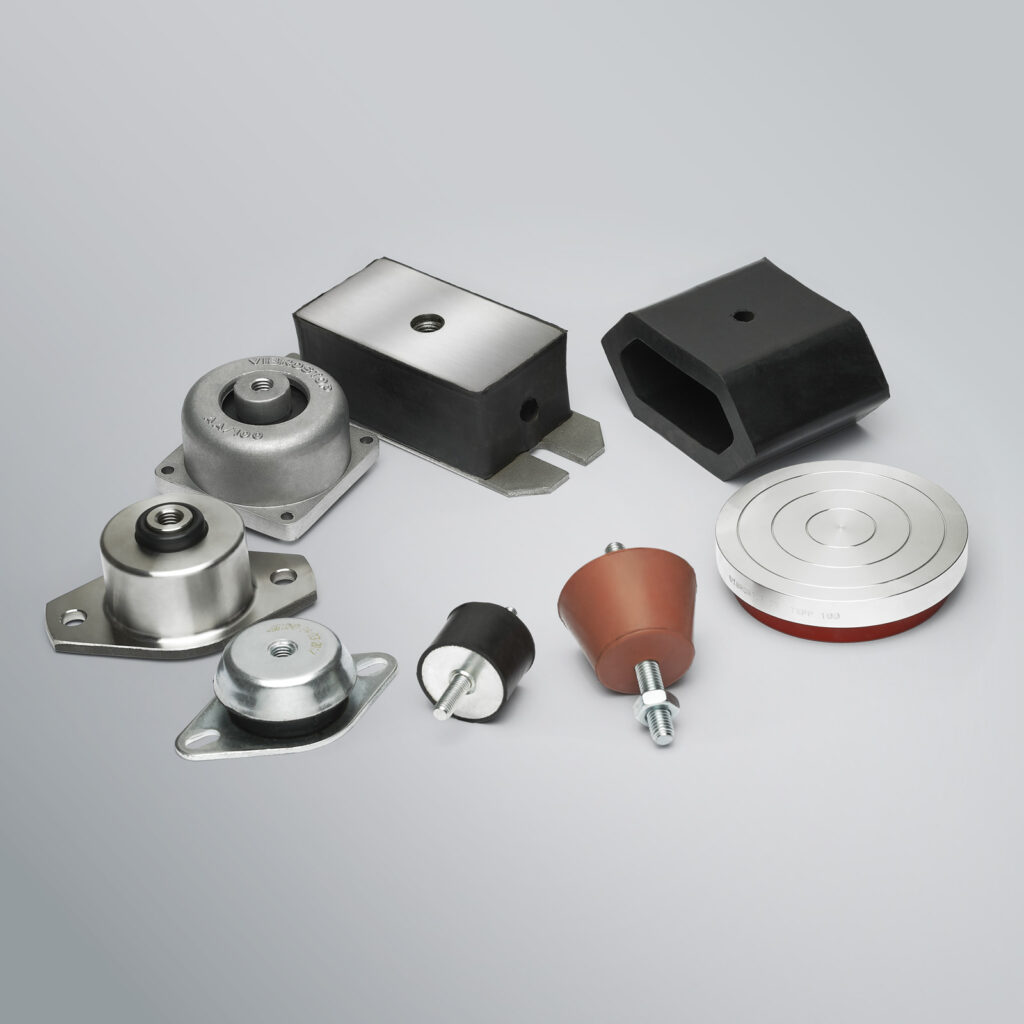
High damping, compact, cost-effective. Natural frequency 8–25 Hz. Ideal for HVAC, compressors, fans and light industrial machinery.
View products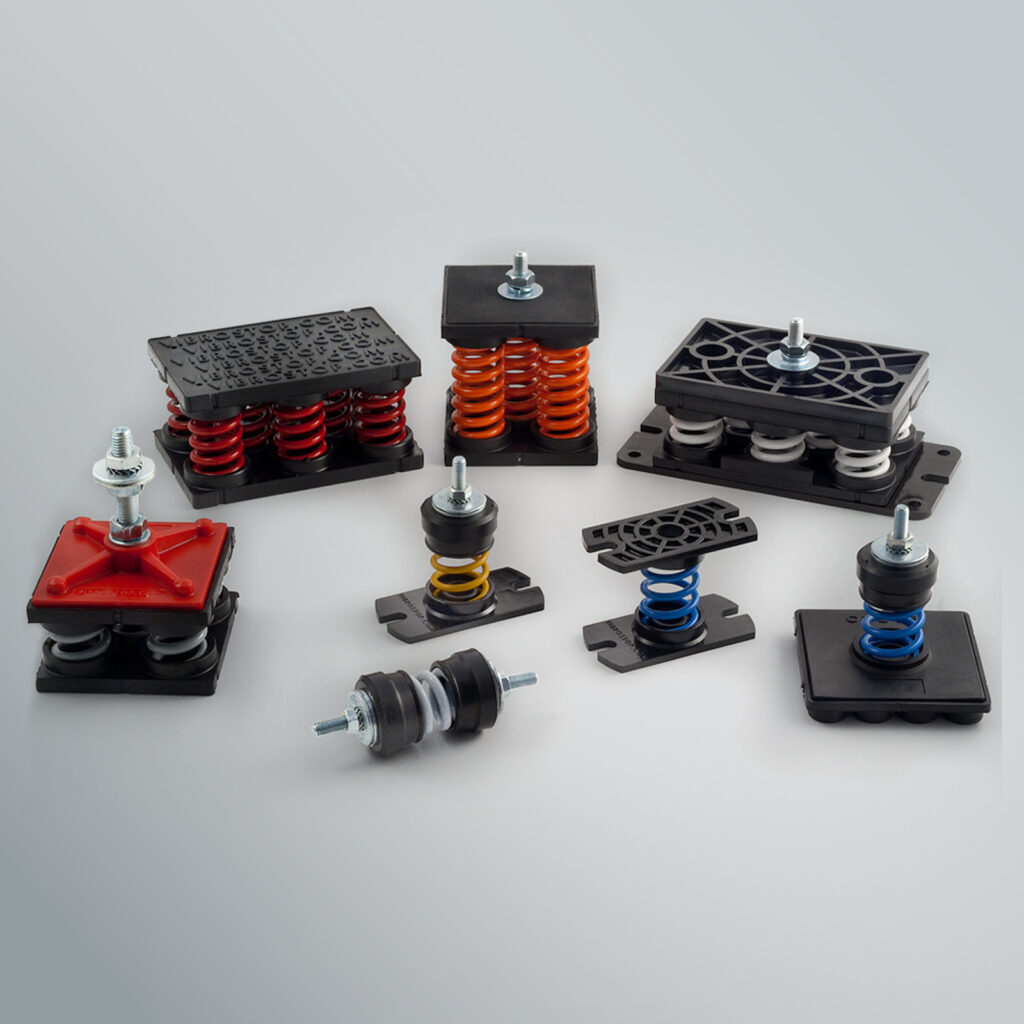
Excellent low-frequency isolation (1–3 Hz), high load capacity, long service life. For heavy machinery, power plants and energy installations.
View products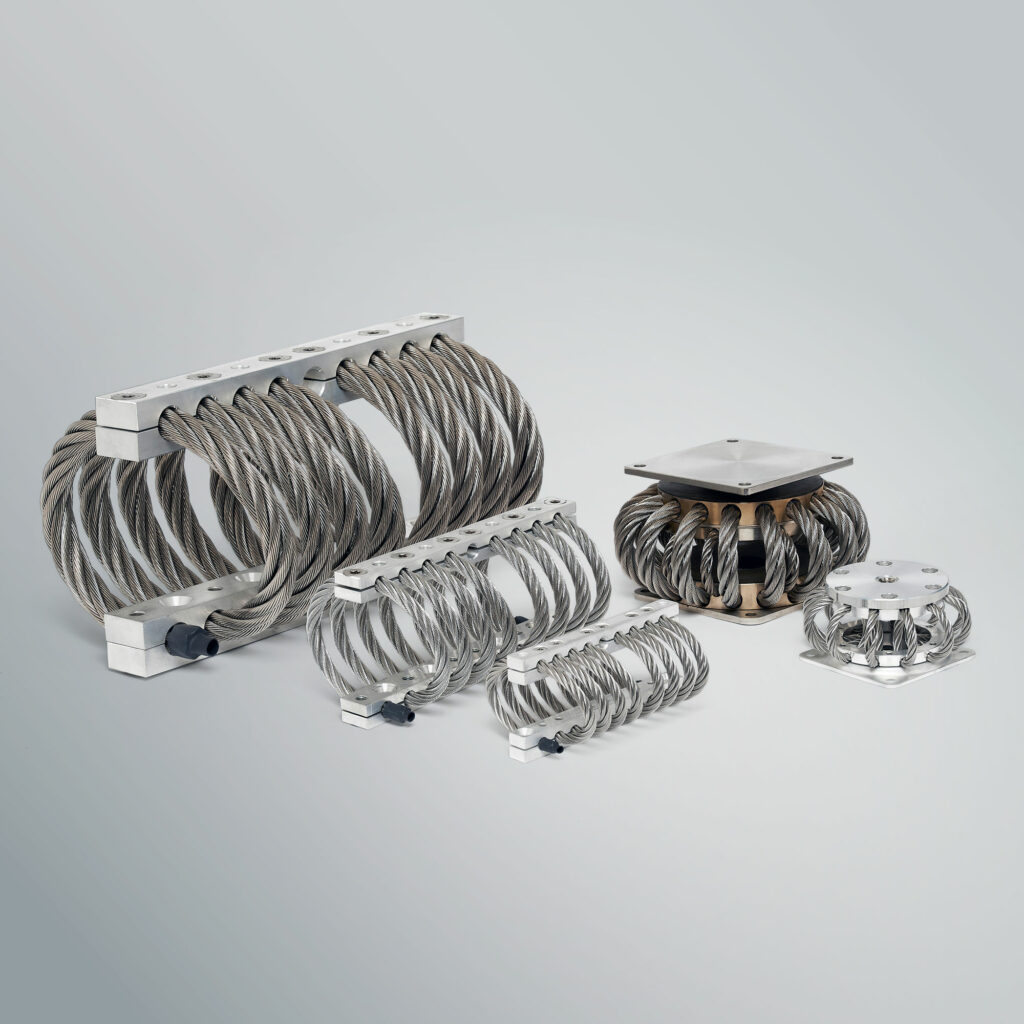
Multi-directional, corrosion-resistant, operational from –60 to +250 °C. For naval, aerospace, military and harsh-environment applications.
View products| Parameter | Rubber / Elastomer | Helical Spring | Wire Rope Inox |
|---|---|---|---|
| Damping (D) | High (3–8%) | Negligible (<0.5%) | Medium (5–15%) |
| Typical natural frequency | 8 – 25 Hz | 1 – 3 Hz | 5 – 50 Hz |
| Low-frequency isolation | Medium | Very high | High |
| Load capacity | Medium | High | Variable |
| Operating temperature range | –20 / +80 °C | –40 / +150 °C | –60 / +250 °C |
| Corrosion resistance | Limited | Medium | Very high |
| Typical service life | 5–10 years | 15–25 years | 25–30+ years |
| Relative cost | Low | Medium | Medium-high |
Where anti-vibration mounts are used
Anti-vibration mounts are used in any context where a mechanical system generates vibrations that must not be transmitted to the surrounding structure or to users. Fields of application are extremely varied:
Technical criteria for correct selection
Selecting an anti-vibration mount cannot be based on empirical criteria or simple price comparison. It requires a structured analysis starting from the real operating data of the system to be isolated. The key parameters to evaluate are:
- Excitation frequency (fd) — derived from the machine's rotational speed (rpm ÷ 60 = Hz). This is the most critical parameter: it determines which technology is appropriate and what natural frequency the suspension must have.
- Total mass and load distribution — the machine mass divided by the number of support points gives the load per mount and the expected static deflection.
- Required isolation level — expressed as a target percentage isolation (e.g. 90%, 95%, 98%). This determines the required fd/fn ratio.
- Environmental conditions — temperature, humidity, presence of corrosive or chemical agents. These determine whether elastomer is suitable or whether stainless steel is required.
- Presence of shocks or impulsive loads — if the system is subject to impacts, the mount must have energy absorption capacity, not just isolation performance.
- Service life and maintenance requirements — for inaccessible or critical installations, component service life is as decisive a parameter as vibration performance.
Frequently asked questions about anti-vibration mounts
Do you have a machine to isolate?
Vibrostop supports engineers and designers in sizing anti-vibration mounts for any industrial, naval or aerospace application. Request a technical consultation