

In today’s industrial landscape, sustainability is no longer limited to energy efficiency or emissions reduction. It increasingly involves durability, reliability and efficient use of resources over time.
In this context, vibration isolation plays a strategic and often underestimated role. It is not only about improving acoustic comfort or protecting structures, but about addressing one of the key pillars of industrial sustainability: optimizing the lifecycle of equipment and systems.
The link between vibrations and resource consumption
Vibrations generated by industrial machinery are one of the main causes of:
- accelerated mechanical wear
- structural loosening
- premature component degradation
- increased maintenance requirements
These effects directly lead to higher resource consumption, including frequent replacements, downtime and additional material use.
Reducing vibrations therefore means reducing resource waste throughout the entire lifecycle of the system, with both economic and environmental benefits.
Agenda 2030 and SDG 12: responsible consumption and production
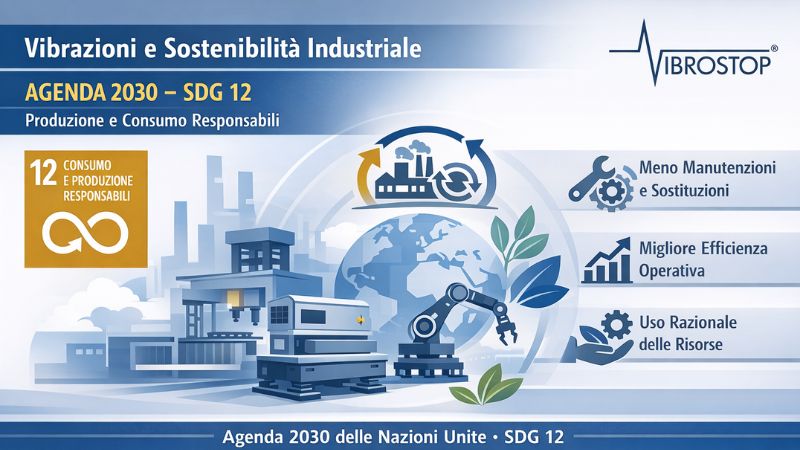
The United Nations 2030 Agenda identifies Sustainable Development Goal 12 (SDG 12) as a key pillar for sustainable development: ensuring responsible consumption and production patterns.
In industrial environments, this translates into:
- more efficient use of resources
- waste reduction
- extended product lifespan
- optimized production processes
The adoption of technical solutions that enhance durability and reliability is fully aligned with this vision.
The contribution of vibration isolation
Anti-vibration technologies, such as those developed by Vibrostop, directly address the causes of mechanical stress by:
- limiting the transmission of vibrations to structures
- reducing stress on components
- improving operational stability of machinery
This results in a significant extension of equipment lifespan and a reduction in maintenance activities.
In other words, vibration isolation becomes a practical tool for implementing sustainability principles without changing production processes, but by improving their efficiency.
A sustainability approach based on durability
One of the most relevant — and often overlooked — aspects of industrial sustainability is system durability.
A longer-lasting system:
- consumes fewer resources over time
- requires fewer replacements
- generates less waste
- reduces the overall impact of production
From this perspective, vibration isolation solutions represent a technical lever that shifts from a consumption-based approach to one focused on resource optimization and preservation.
Practical applications: HVAC and industrial machinery
The contribution of vibration isolation to sustainability is particularly evident in applications such as:
HVAC/R systems
Air handling units, chillers and heat pumps benefit from reduced vibration levels, improving efficiency and limiting component wear.
Industrial machinery
Presses, machine tools and complex production systems maintain more stable performance over time, reducing downtime and unexpected maintenance.
In both cases, the result is a more efficient, reliable and sustainable system.
Vibration isolation is a key technology for improving industrial system performance, but also a concrete contributor to the objectives of the United Nations 2030 Agenda.
Supporting Goal 12 – Responsible Consumption and Production means adopting solutions that improve resource efficiency, reduce waste and extend system lifecycle.
In this context, Vibrostop solutions represent a technical approach capable of combining efficiency, reliability and sustainability, meeting the demands of modern industry.
👉 Discover Vibrostop solutions for vibration isolation in industrial and HVAC applications and improve the efficiency and lifespan of your systems.